Last updated November 18, 2026

Free written scope consultation - allowances, timeline, and change-order rules on paper before a single trade is scheduled
Driveway & Pavers Warning Signs Every Homeowner Should Know
A single sunken paver is not a cosmetic issue. It’s a structural signal, and the question is whether you catch what it’s telling you now or find out in three years when the whole section needs replacing. Most homeowners wait for the crack they can see from the street before they call anyone. Here’s what we’ve learned after years of tearing out failed driveways across Vacaville: the expensive failures almost always started as something small that went unread. In this guide you’ll learn the five visible signs that base failure is already underway, how to tell early edge creep from advanced movement, what standing water reveals about your original drainage, how to separate normal weathering from seal failure, and exactly when a small problem has a narrow repair window. Vacaville’s clay-heavy soil and hot, dry summers make these signals show up faster here than in most of California.
Quick Answer
The warning signs of driveway and paver trouble are sunken or rocking pavers, sand washing out of the joints, edge creep where the border pushes outward, standing water that lingers more than a few hours after rain, and discoloration that doesn’t match normal weathering. Those five signs point to a base or drainage problem underneath the surface, not surface wear. Catch them early and repair is often a section reset; ignore them and the fix becomes a full-depth rebuild.
Styles & brands we work with
- Kitchen remodeling
- Bathroom remodeling
- Home additions & ADU
- Roofing
- Windows & doors
- Driveway & pavers
- Fence
Table of Contents
- Why the Base Fails First (and Why You See It From Above)
- The Five Visible Warning Signs of Base Failure
- Edge Creep: Early-Stage Versus Advanced-Stage
- What Standing Water Tells You About Original Drainage
- Normal Weathering Versus Discoloration That Signals Trouble
- Second Opinion or Act Now: Reading the Repair Window
- Vacaville Soil, Heat, and What They Do to Pavers
- A 10-Minute Walkaround Checklist
Why the Base Fails First (and Why You See It From Above)
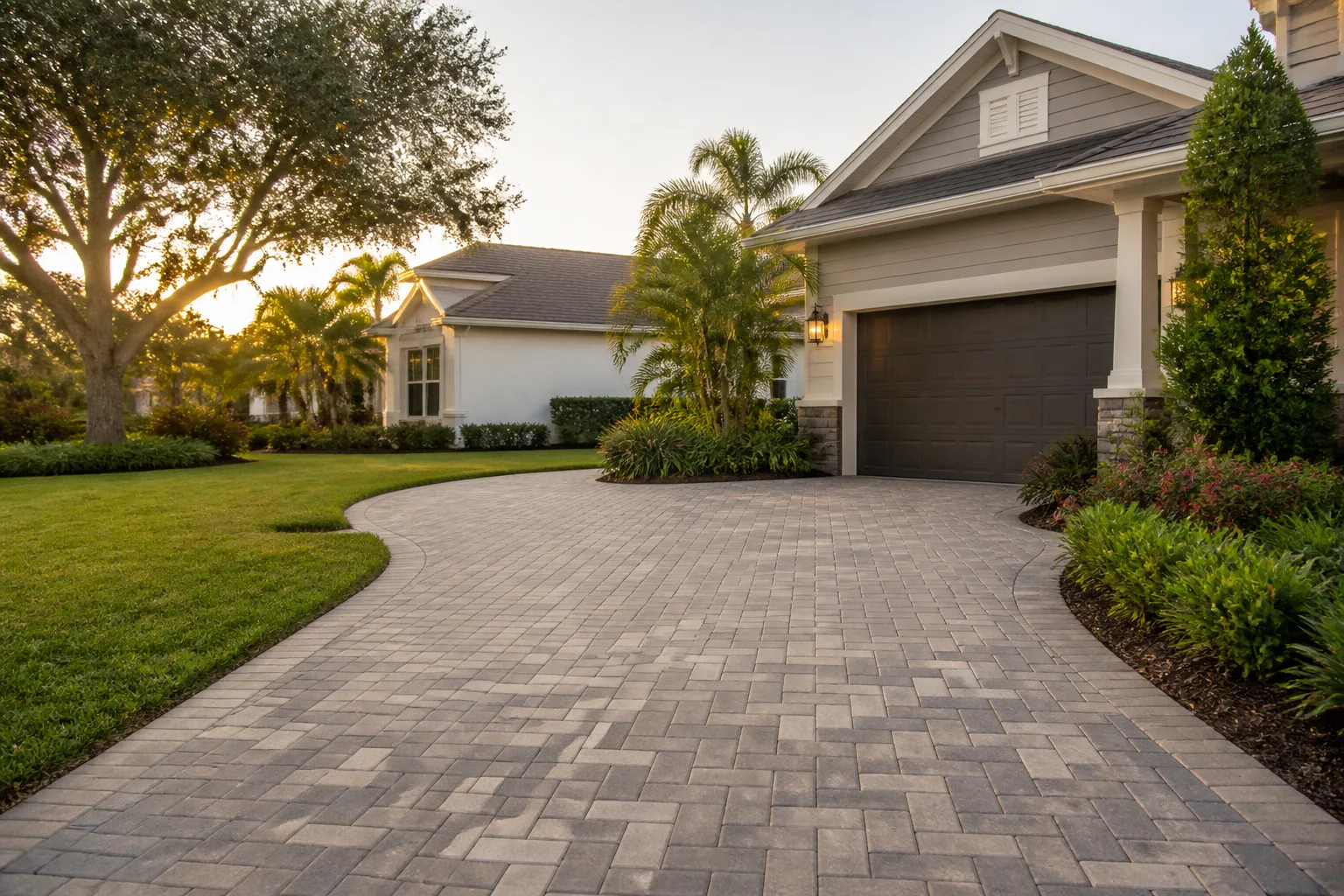
A paver driveway is a layered system. On top you have the pavers, then a bedding layer of sand, then a compacted base of crushed aggregate, then the subgrade soil beneath everything. The pavers themselves are nearly indestructible. Belgard and similar concrete pavers are rated to carry vehicle loads for decades. What fails is almost never the stone. It’s the base, and your driveway’s surface is the only place that failure shows up.
Three things break a base down over time:
- Water infiltration. Water gets into the joints and bedding sand, then into the base. Once the base is saturated, it loses load-bearing capacity and shifts under vehicle weight.
- Poor compaction at install. If the original base wasn’t compacted in shallow lifts, it settles unevenly under traffic. This is a hidden defect that can take a couple of years to surface.
- Soil movement. Expansive clay soils swell when wet and shrink when dry. That seasonal cycle pumps the base and bedding material around and pushes settlement to the surface.
Here in Vacaville, we regularly see all three stacking up on the same driveway. Vacaville sits on soils with a meaningful clay component, especially through older neighborhoods and the areas toward the hills, and the summers run hot and dry. A base that was borderline at install will start showing signs within a few years. The surface tells you what’s happening underneath, but only if you know what to look for. That’s the whole point of this guide.
The Five Visible Warning Signs of Base Failure
Forget what you’ve heard about waiting for a crack. These five signs are the ones that tell you base failure is already underway, and each one points to a different stage of the problem. Walk your driveway this weekend and check for all five.
- Sunken or rocking pavers. A single paver lower than its neighbors, or one that rocks slightly when you step on it, means the bedding sand beneath it has migrated. That sand went somewhere, and it usually went into a void in the base. One sunken paver is the most common first sign.
- Sand washing out of the joints. If the joints between pavers are noticeably deeper than they were, or you find sand collecting at the bottom of the driveway after rain, the joint sand is eroding and the whole system is losing its interlock. Without sand, the pavers shift.
- Edge creep. The border pavers push outward and away from the field. We cover this in its own section below because the stage matters enormously.
- Depressions or “birdbaths.” Low spots where water collects after rain, often in the middle of the driveway where tires track. These aren’t settling over decades. They form because the base has lost volume in one area.
- Widening joints. Joints that are tight in one section of the driveway and visibly open in another tell you the pavers are moving independently of each other. That’s a broken interlock, and it accelerates.
Any one of these signs on its own is worth watching. Two or more together in the same area means the base there is already compromised, and the surface is simply reflecting it.
Edge Creep: Early-Stage Versus Advanced-Stage
Edge creep is the outward migration of the border pavers. It happens when the edge restraint (the concrete curb or plastic edging that holds the pattern together) has failed, or when the base along the edge wasn’t built deep enough to resist lateral load. It’s the most misdiagnosed problem we see on Vacaville driveways, because early-stage creep looks harmless and advanced-stage creep looks like a small cosmetic issue. They are not the same repair.
Here’s how to tell them apart:
- Early-stage creep. The gap between the border pavers and the field is under about a quarter inch, the border pavers are still level, and the edge restraint is intact but the pavers have shifted slightly against it. The repair is often to re-set the affected border pavers, re-apply joint sand, and check the restraint. It’s a same-area fix.
- Advanced-stage creep. The gap is wider than a quarter inch, the border pavers sit lower or ride higher than the field, and you can see daylight, exposed edging, or a void where the restraint used to hold. At this stage the restraint has failed and the paver underlayment along the edge has washed out. The fix requires excavating the border, rebuilding the edge base, re-setting the restraint, and re-installing the pavers, not just re-sanding joints.
If you let advanced-stage creep continue, the border eventually separates enough that the field pavers begin to spread toward the gap. At that point you’re re-laying the whole outer run, not just the border. On a driveway in Vacaville where the slope carries water toward the street, that erosion runs fast during the rainy season. Check the edge after every big storm and you’ll catch it in the cheap stage.
What Standing Water Tells You About Original Drainage
Water pooling on or beside your driveway for more than a few hours after rain is not a landscaping detail. It’s a report on how the driveway was originally engineered, and it will not self-correct. Water finds the lowest point, and if that low point is on your driveway, the driveway was built with an inadequate slope, a missing drainage channel, or a grading plan that ignored where the site actually drains.
Three patterns to watch for:
- Pooling in the middle of the drive. The base has settled in the wheel tracks and created a depression. The water that pools there then infiltrates and accelerates the base failure. It’s a feedback loop, and it only gets worse.
- Pooling along the house side. This is the one to take seriously immediately. Water against the foundation or the garage slab finds its way in. It can also undermine the paver bedding at the house edge, which is why we see house-adjacent edge failures far more often than street-adjacent ones.
- Pooling at the street apron. If the driveway doesn’t meet the street with a clean transition, water backs up at the apron and sits. That’s a grading problem at the transition, and in Vacaville it also means water sits against the concrete gutter line, which is where we see the earliest deterioration.
The fix for standing water isn’t to add more sand to the low spot. That just moves the problem. It’s to identify where the water should have gone originally, whether that’s a channel drain, a slope correction, or a grading change, and build it in. That’s a repair that belongs in a professional scope, not a weekend project.
Normal Weathering Versus Discoloration That Signals Trouble
All driveways change color. Concrete pavers lighten and darken with the seasons, and a driveway that’s ten years old will not look like one that was installed last month. That’s normal. What isn’t normal are the patterns that point to seal failure, moisture intrusion, or chemical damage. Knowing the difference saves you from a seal-and-wait problem that’s actually a base-and-drainage problem.
Here’s the quick way to read it:
- Uniform fading. Normal. The pigment weathers evenly, and the whole surface dulls together.
- Patchy dark or wet-looking areas that don’t dry after the rest of the surface does. This is moisture trapped in the base or bedding. The base is holding water, and the pavers over that spot stay darker because they’re wicking it up. This is the single most overlooked sign of hidden base saturation.
- Efflorescence (white powdery film). A little after install is normal. Recurring efflorescence that returns after every wet season means water is moving through the system repeatedly, which means the drainage or base integrity needs a look.
- Black or green staining in the joints. Usually organic growth, often in shaded sections. Not a base problem on its own, but it tracks where moisture lingers.
- Chemical staining (irregular, sharp-edged, often rusty or bleached). Fertilizer, de-icer, or oil spills. Not structural, but it can accelerate surface wear and hide a real problem.
In our experience, “patchy dark areas that don’t dry” is the sign homeowners miss most often in Vacaville. The dry summer hides it. When the first winter rains come and one section of the driveway stays dark for days, that’s your base telling you it’s saturated and needs professional attention. A residential paver sealer will not fix moisture coming from below.
Second Opinion or Act Now: Reading the Repair Window
Some paver problems have a wide repair window and some have a narrow one. Getting the timing right saves real money, and getting it wrong is the difference between a section repair and a full driveway replacement. Here’s how we advise homeowners to sort their findings.
Get a second opinion if:
- You see one sunken paver but no water issues, no edge movement, and no widening joints elsewhere. Wait to see if the depression grows, and have it looked at during a normal estimate appointment.
- The discoloration is uniform and the pavement is flat and stable. It may be surface wear that doesn’t need immediate action.
- You’ve had one contractor recommend a full replacement without a clear diagnosis of why the base failed. A contractor who can’t tell you what caused the failure can’t tell you a replacement will fix it.
Act immediately if:
- The driveway holds water within three feet of the foundation or garage slab after rain. This one is a home-integrity issue, not a paver issue, and it’s worth a professional look right away.
- You have two or more of the five warning signs in the same section. That’s a compromised base in the active stage, and the repair scope grows with every rainy season.
- The edge restraint has clearly separated or broken. Advanced-stage edge creep with a visible void should be rebuilt, not monitored, because the field pavers will start chasing the gap.
- You’re seeing wheel-track depressions that weren’t there a year ago. The base is actively losing volume, and it will not stop on its own.
Getting an estimate early costs you nothing and gives you a baseline. Groundwork Construction Co. of Vacaville offers the Driveway & Pavers in Vacaville service with an upfront, written scope, so you know exactly what stage your driveway is in before you spend anything.
Vacaville Soil, Heat, and What They Do to Pavers
Driveway problems aren’t universal. They’re driven by local climate and local soil, and Vacaville has a specific combination that makes some failure modes more common here than elsewhere in the region. Knowing this helps you read your own driveway against what’s most likely to be happening underneath it.
- Clay-rich soil and the wet/dry cycle. Vacaville soils hold water and move with the seasons. A base built over clay without proper drainage is the most common cause of the edge creep and sunken paver patterns we see across Vacaville neighborhoods.
- Hot, dry summers. Extended heat drives water out of the base and the soil beneath it. When the soil shrinks, the base loses support. When the winter rains return, that support doesn’t come back evenly. Years of this cycle create the depressions and wheel-track settlement that might look like normal wear.
- Concentrated winter rains. Vacaville gets its rain in concentrated bursts, and it arrives over a base that’s been dried out all summer. That first storm is when we see the most edge and house-side failures. Every paver driveway owner in Vacaville should walk their drive after the first big rain of the season.
- Mature trees. Large tree root systems near the driveway surface the drive and can lift sections. This is a genuine structural problem, and it’s why we advise homeowners to check the trees on both sides of the driveway during the walkaround.
None of these factors mean your driveway is doomed. They mean the base and drainage decisions during install carry more weight in Vacaville than they would in a milder climate. When we design and install a driveway here, we spec deeper, well-compacted base and positive drainage away from the structure.
A 10-Minute Walkaround Checklist
This is the walkaround we recommend to every homeowner, and it’s the single most useful habit for catching a driveway problem while it’s still a small repair. Do it twice a year: once in late spring and once after the first big fall rain.
- Walk the full perimeter. Look at the border pavers from every angle. Check for gaps between border and field, pavers sitting proud or low, and any daylight visible under the edging.
- Step on each section. Any paver that rocks, feels loose, or sounds hollow when you step on it is a signal to mark it with chalk and watch it.
- Look at the joint sand level. If the joints are noticeably shallower than when the driveway was installed, or if you find sand at the low end, note it.
- Check the drainage path after rain. Within a few hours of a rain event, look for any low spot still holding water, especially near the foundation and at the street apron.
- Note color irregularities. Look for patchy dark sections that stay wet longer than the surrounding pavers.
- Check the transition to the street and to the house. Both are common failure zones, and both are quick to inspect.
- Look at nearby trees. Roots that have surfaced near the driveway are worth noting before they lift a section.
Log what you find with photos and the date. That log is gold when you have a professional estimate done, and it gives you a baseline to compare against next season.
Common Mistakes to Avoid
- Filling a sunken paver with sand and calling it done. Sand doesn’t fix a void in the base. It fills the visible gap and hides the fact that the base beneath has already lost volume. Two seasons later the paver is lower than it started.
- Ignoring edge creep until it’s advanced. Early-stage edge creep is a cheap fix. Advanced-stage edge creep is a full border rebuild. Homeowners in Vacaville tend to watch it for a couple of years before acting, and that’s exactly the wrong approach given the pace the winter rains move it along.
- Pressure-washing the whole driveway to “reset” the surface. Aggressive pressure washing blasts joint sand out and accelerates the very problem you’re trying to solve. A gentle wash with the right nozzle is fine. Blasting with a wide, high-pressure tip is not.
- Assuming the pooling water is a yard grading problem. Pooling on the driveway is a driveway engineering problem, and it needs to be fixed at the driveway, not by adding a drain somewhere else in the yard.
- Sealing the driveway over a moisture problem. Sealing pavers that have trapped moisture underneath locks the moisture in. The surface stays dark, the problem gets worse, and you’ve spent the money twice.
- Calling a landscaper for a paver base repair. Base and edge restraint work is hardscape construction, not landscaping. It needs the right compaction equipment and the right base specification, or the fix fails again in the same spot.
- Accepting a verbal diagnosis without a written scope. Any estimate for a paver repair should tell you what failed, why, and what’s being done about it. A written line-item scope is how you protect yourself, and it’s what you should expect from any contractor working on your home.
See the difference
 Before
 After
 Before
 After
 Before
 After
When to Call a Professional
Call a professional when you see two or more warning signs in the same section, when water is pooling within three feet of the foundation, when the edge restraint has separated or broken, or when a wheel-track depression has appeared in the last year. Any of those points to a base or drainage problem that won’t resolve on its own and won’t respond to a surface fix. One sunken paver with no other signs can be assessed during a normal estimate visit. Groundwork Construction Co. of Vacaville offers free estimates in Vacaville, and every repair starts with an upfront written scope. Call (888) 276-8078 to schedule your free estimate, and we’ll walk the driveway with you before anything is decided.
If your driveway work is part of a larger project, our Home Additions & ADU in Vacaville service handles the grading and hardscape around a new structure. If you’re also planning to replace a boundary fence during the same exterior refresh, our Fence Installation in Vacaville service covers the fencing side of that work. Both come with the 730-Day Done Right Promise, the same guarantee we extend to every driveway and paver project. You can see our full scope on the Groundwork Construction Co. of Vacaville home page.
Frequently Asked Questions
A single paver that sits lower than its neighbors or rocks slightly when you step on it is usually the first visible sign of a base problem. The paver itself is fine. The bedding sand beneath it has migrated into a void in the base, which is why the paver feels loose. If you notice one, mark it and check whether the depression grows over the next few months. If it does, get an estimate. Call (888) 276-8078 and we’ll take a look at your Vacaville driveway.
The cost depends on how much of the base needs rebuilding. A same-area reset on a small section is typically in the low hundreds to a few hundred dollars, while a full border rebuild or drainage correction runs higher. The honest answer is that the number varies with the scope, which is why we recommend a written line-item estimate before any work starts. Our estimates are free, and the number you see is the number you pay. Call (888) 276-8078 to schedule yours.
Top-dressing the joints with sand is routine maintenance and worth doing, but it does not fix a sunken section. If the depression is caused by base loss, adding sand to the joints hides the symptom without fixing the cause, and the depression returns the next wet season. The right fix is to open the affected section, rebuild the base under it, and re-set the pavers. Call (888) 276-8078 for an estimate.
A patch of pavers that stays dark longer than the rest of the driveway is almost always holding moisture in the base beneath it. That’s a base saturation problem, not surface staining, and it’s the sign that most often goes unnoticed in Vacaville because the dry summer hides it. Sealing over it makes the problem worse. Get it looked at before the next rainy season. Our estimates are free – call (888) 276-8078.
If the gap between the border pavers and the field is wider than about a quarter inch, if the border pavers are noticeably higher or lower than the field, or if you can see a void or exposed edging, it’s advanced-stage and the border needs rebuilding. A gap under a quarter inch with level pavers and an intact restraint is usually early-stage and fixable without a full rebuild. When in doubt, call (888) 276-8078 and we’ll tell you which stage you’re in.
Yes. We repair and rebuild driveway projects regardless of who installed them originally. Every repair is scoped upfront in writing and covered by the 730-Day Done Right Promise, which means if the workmanship fails, we make it right. Our technicians have up to 12 years of experience with paver base and drainage work in Vacaville and neighboring communities. Call (888) 276-8078 to schedule a free estimate.
The Bottom Line
Your driveway is telling you what’s happening underneath it, and the five signs in this guide are how to read the message early. Sunken pavers, sand washing out of joints, edge creep, standing water, and patchy discoloration all point to base or drainage problems you can fix now for a fraction of what a full rebuild costs later. In Vacaville, the clay soils and concentrated winter rains compress the timeline, so a fall walkaround after the first big rain is the highest-value ten minutes you’ll spend on your home this season. Read the signs, log what you find, and get a written estimate while the repair is still small. When the driveway needs professional attention, call (888) 276-8078 for a free estimate from Groundwork Construction Co. of Vacaville.
Written by the team at Groundwork Construction Co. of Vacaville.